
305-468-3314

3650 NW 82nd Avenue, Suite 502, Miami, FL 33166



A kidney tumor is frightening news, and the follow-up question is usually practical: where should I be treated? Maine has its own cancer programs. MaineHealth, for example, lists laparoscopic and robotic surgery, ablation, and drug therapy among its kidney cancer treatments, and Central Maine Healthcare also runs a cancer program. For many people, care close to home is the sensible choice.
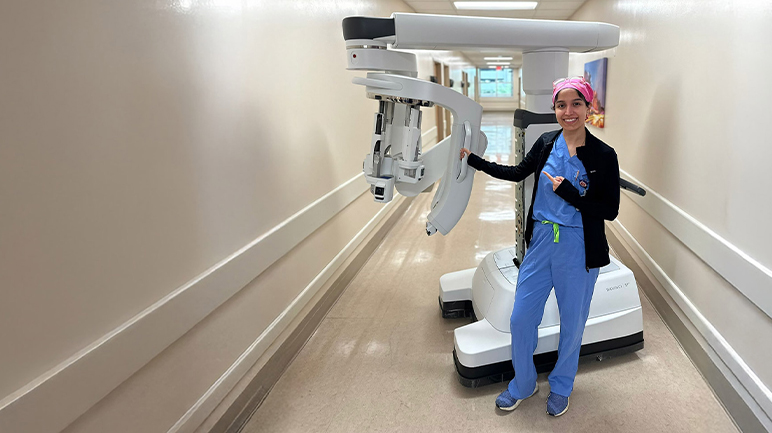
This page is for Maine patients who want another perspective, or who are interested in a surgeon who performs Single Port robotic surgery. Dr. Shirin Razdan is a urologic oncologist and robotic surgeon in Miami, Florida, who treats kidney cancer. She does not have a Maine office, so the usual first step for Maine patients is a conversation and a review of scans, not a trip. The rest of this page covers the facts, the options, and what it may cost.
Kidney Cancer in Numbers
The statistics below are national, from the American Cancer Society and the SEER database.
| Question | Answer |
| How many Americans are diagnosed each year? | An estimated 80,450 |
| How often is it found before it spreads? | About 65.7% of the time |
| What is 5-year survival if it stays inside the kidney? | 93.3% |
| What is 5-year survival for all stages combined? | 79.2% |
| Which type is most common? | Renal cell carcinoma, about 90% of cases |
| Who is affected most? | Men roughly twice as often as women; the average age at diagnosis is in the mid-60s |
Put simply, most kidney cancers are caught while they are still very treatable. For more on stages, outlook, and typical expenses, see our overview of kidney cancer symptoms, survival rates, and treatment cost.
From Scan to Operating Room: The Usual Sequence
- A mass shows up. Often it is spotted by accident on an ultrasound or CT done for another reason. Early tumors rarely hurt.
- More testing. Expect urine and blood tests, and usually a dedicated CT or MRI to map the tumor. A biopsy is used only in some cases.
- A plan is chosen. The choices are watching the tumor, ablating it, or removing it. Size, position, and your overall health drive the decision.
- Surgery, if recommended. The operation either saves the healthy part of the kidney (partial nephrectomy) or removes the whole organ (radical nephrectomy).
- Follow-up. Scheduled scans and blood tests check kidney function and look for recurrence.
Your Options and the Questions Worth Asking
| Option | Who it usually suits | A good question to ask |
| Active surveillance | Small, slow-growing tumors, or people who are poor candidates for surgery | How often will I be scanned, and what would make you change course? |
| Partial nephrectomy | Tumors that can be removed while sparing the kidney | Is saving my kidney realistic with this tumor? |
| Radical nephrectomy | Larger or more centrally placed tumors | Why can the kidney not be saved in my case? |
| Robotic nephrectomy | Patients whose tumor suits a minimally invasive approach | How many of these do you do each year? |
| Ablation | Small tumors when major surgery is risky | How will you confirm the tumor is fully treated? |
| Immunotherapy or targeted drugs | Cancer that has spread beyond the kidney | Which oncology team will manage this, and where? |
Dr. Razdan’s work is on the surgical side. When drug therapy or radiation is part of a treatment plan, it is delivered by medical and radiation oncology teams, which she coordinates with. For a longer comparison, read our guide to kidney cancer treatment options.
What Kidney Surgery May Cost
Honest answer: it varies a lot, and nobody can quote your price without your specifics. One public reference point is MDsave, a marketplace for self-pay patients. It lists bundled cash prices for a laparoscopic partial nephrectomy of roughly $17,000 at some U.S. facilities, while estimating the national average near $38,000. Those listings cover facility and physician fees for the laparoscopic version of the operation. They are not prices for robotic or Single Port surgery, and they are not what an insured patient would pay.
| What affects your bill | Why it matters |
| Insurance vs. self-pay | Insurers negotiate rates; self-pay prices can be higher or lower depending on the facility |
| Type of operation | Partial and radical nephrectomy, and open, laparoscopic, and robotic approaches, are priced differently |
| Hospital stay | Room charges are a large part of the total, so a shorter stay can lower the bill |
| Drug treatment | If needed, it is usually billed through insurance and varies widely by medicine and regimen |
| Scans and follow-up | Surveillance imaging recurs for years and adds up |
Before you commit anywhere, ask for an itemized estimate and check coverage with your insurer. Our page on insurances accepted lists the plans the practice works with, and the office can tell you how out-of-state coverage typically works.
How a Second Opinion From Maine Works
- Request the images, not just the report. Ask your hospital for the CT or MRI on a disc or secure link, plus any pathology and recent kidney blood tests.
- Call 305-468-3314. Ask whether a virtual consultation is available for your situation and what the office needs from you first.
- Bring your questions. A tumor described as “complex” can mean several different things, and our explainer on what it means when a kidney tumor is called complex can help you ask better ones.
- Compare before you decide. A second opinion may confirm your current plan, which is also a useful result.
Frequently Asked Questions
Can I get good kidney cancer care without leaving Maine?
Yes. In-state programs treat kidney cancer, and MaineHealth lists robotic surgery, ablation, immunotherapy, targeted therapy, and radiation among its options. Many patients never need to travel.
Does Dr. Razdan have an office in Maine?
No. Her practice is in Miami. Maine patients can call 305-468-3314 to ask about a virtual review of their records.
What are the chances of survival?
Five-year relative survival is 93.3% when the cancer is confined to the kidney and 79.2% across all stages combined.
Do all kidney tumors need to come out?
No. Some small tumors are monitored with regular scans, and others are treated with ablation. Tumors that are larger or growing are usually removed.
What if I cannot have surgery?
Ablation, careful monitoring, and drug therapy are alternatives depending on the situation. Your care team can explain which apply to you.
Is immunotherapy a treatment for kidney cancer?
Yes, mainly for cancer that has spread. It is prescribed by medical oncologists and is available through in-state cancer programs as well as elsewhere.
How much does kidney surgery cost?
It depends on the operation, the facility, and your insurance. Published cash prices for one laparoscopic partial nephrectomy listing run from about $17,000 at some facilities to an estimated national average near $38,000. Ask for an itemized estimate for your own case.
Should I get a second opinion?
Yes. It is standard good practice for any cancer diagnosis. To learn more about the surgeon’s training, visit the about page for Dr. Shirin Razdan.