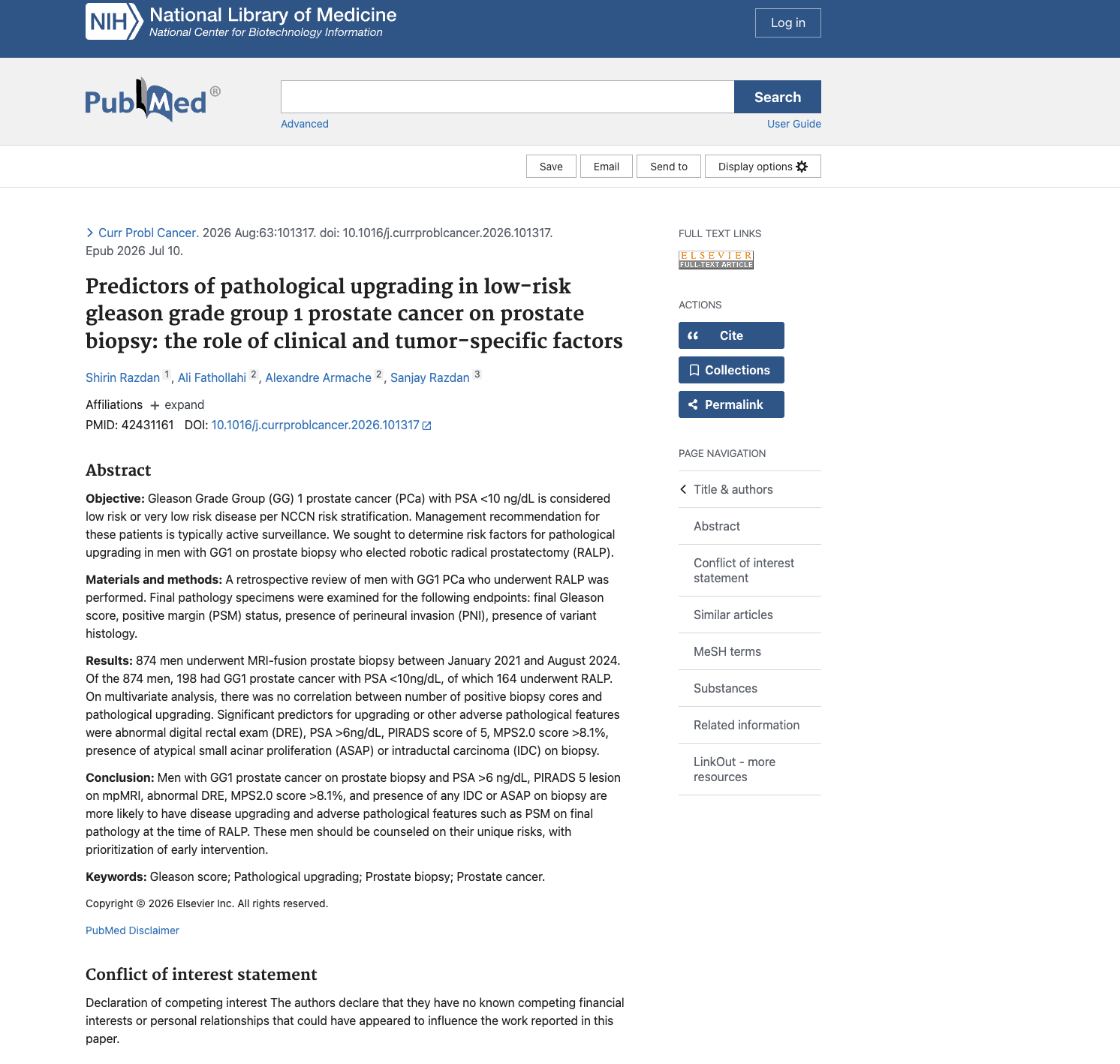
Led by Dr. Shirin Razdan | Published in Current Problems in Cancer (August 2026)
Prostate cancer is one of the most common diagnoses among men today. When a patient first hears the word “cancer,” the immediate instinct is often to act quickly and aggressively. However, modern urology has evolved significantly. For many men diagnosed with what is known as “low-risk” prostate cancer, the most highly recommended course of action is not immediate surgery or radiation, but rather a closely monitored strategy called “active surveillance.”
But what happens when a cancer that appears low-risk on paper is actually harboring more aggressive tendencies hiding beneath the surface?
This critical question is at the heart of groundbreaking new research led by Dr. Shirin Razdan, a leading expert in urologic oncology and robotic surgery. Published in Current Problems in Cancer in August 2026, her latest study provides crucial insights into identifying which men diagnosed with low-risk prostate cancer are actually at a higher risk of disease progression, and who might benefit from early surgical intervention rather than watchful waiting.
Understanding Prostate Cancer Grading and Active Surveillance
To fully grasp the significance of Dr. Razdan’s research, it is important to understand how prostate cancer is classified. When a patient undergoes a prostate biopsy, the tissue is examined under a microscope and assigned a Gleason score, which is then grouped into a Gleason Grade Group (GG). Gleason Grade Group 1 (GG1) prostate cancer, particularly when accompanied by a Prostate-Specific Antigen (PSA) level of less than 10 ng/dL, is universally considered low-risk or very low-risk disease according to the National Comprehensive Cancer Network (NCCN) risk stratification guidelines.
Because GG1 cancer typically grows very slowly and may never pose a life-threatening risk, the standard of care is active surveillance. This involves closely monitoring the cancer through regular PSA blood tests, digital rectal exams (DRE), prostate MRIs, and periodic repeat biopsies. The goal is to spare the patient from the potential side effects of treatment—such as urinary incontinence or erectile dysfunction—for as long as safely possible.
For many men, active surveillance is highly successful and perfectly safe. However, biopsies are essentially sampling procedures; they capture small fragments of tissue from a large gland. There is always a risk that the biopsy needle simply missed a more aggressive, higher-grade portion of the tumor.
The Clinical Dilemma: The Risk of Pathological Upgrading
The medical term for this phenomenon is “pathological upgrading.” This occurs when a patient is diagnosed with low-risk GG1 cancer based on their initial biopsy, but after undergoing a robotic radical prostatectomy (RALP)—where the entire prostate gland is removed and meticulously analyzed by a pathologist—the final results reveal a higher grade, more aggressive cancer than initially suspected. Upgrading can also reveal adverse pathological features, such as positive surgical margins (PSM) or perineural invasion (PNI), meaning the cancer was beginning to spread beyond the immediate confines of the prostate gland.
Dr. Razdan and her team recognized this serious clinical dilemma. If urologists rely solely on the broad NCCN baseline guidelines, some men with hidden aggressive disease might be placed on active surveillance, losing valuable time and allowing the cancer to grow. The research team set out to determine if there were specific, identifiable risk factors—preoperative red flags—that could predict which GG1 patients were most likely to experience this dangerous pathological upgrading.
The Study: A Comprehensive Review of Clinical Factors
To find these answers, Dr. Razdan and her co-authors conducted a rigorous, large-scale retrospective review. The study evaluated 874 men who underwent advanced MRI-fusion prostate biopsies between January 2021 and August 2024. MRI-fusion biopsies are state-of-the-art diagnostic tools that overlay detailed MRI images with real-time ultrasound to precisely target suspicious lesions in the prostate, offering far more accuracy than traditional biopsies.
Out of this large cohort, 198 men were diagnosed with GG1 prostate cancer and had a PSA of less than 10 ng/dL. The researchers specifically focused on a subset of 164 of these men who ultimately elected to undergo robotic radical prostatectomy (RALP). By comparing the initial clinical data and biopsy results of these 164 men directly against the final, definitive pathology reports of their surgically removed prostates, the team could identify exactly which preoperative clues pointed to a worse cancer outcome.
Key Discoveries: Uncovering the Hidden Warning Signs
The results of the multivariate analysis were highly illuminating and provide a vital new roadmap for personalized urological care. Dr. Razdan’s team discovered that several specific clinical and tumor-specific factors act as highly significant predictors for disease upgrading and adverse final pathology.
The study found that if a patient is diagnosed with GG1 prostate cancer, they are at a significantly higher risk of having a more aggressive, upgraded cancer if their preoperative workup includes any of the following warning signs:
- Elevated PSA Levels Over 6 ng/dL: While the NCCN generally considers anything under 10 ng/dL to be low-risk, this study found that patients with a PSA specifically greater than 6 ng/dL had a markedly higher risk of harboring upgraded disease.
- A PIRADS Score of 5 on an MRI: The Prostate Imaging Reporting and Data System (PIRADS) scores lesions from 1 to 5 based on the likelihood of clinically significant cancer. A score of 5 indicates a very high suspicion of aggressive cancer, which should act as a massive warning sign even if the initial biopsy reads as GG1.
- An MPS2.0 Score Greater Than 8.1%: The MyProstateScore 2.0 (MPS2.0) is a specialized, highly sensitive urine test that looks for specific genetic markers associated with prostate cancer. A score exceeding this 8.1% threshold is a strong indicator of hidden clinical risk.
- An Abnormal Digital Rectal Exam (DRE): A physical exam remains a critical diagnostic tool. If a physician feels a nodule or irregularity during a DRE, it is a significant predictor of more advanced disease, regardless of a low-risk biopsy reading.
- Specific High-Risk Biopsy Findings: The presence of specific cellular abnormalities on the biopsy—namely Atypical Small Acinar Proliferation (ASAP) or Intraductal Carcinoma (IDC)—were strong, independent predictors that a much worse cancer was present in the surrounding prostate tissue.
Interestingly, the study also debunked a very common clinical assumption. The researchers found absolutely no correlation between the total number of positive biopsy cores and the risk of pathological upgrading. A patient with just one positive core who has the warning signs above is actually at a significantly higher risk than a patient with several positive cores but none of these specific red flags.
What This Means for the Future of Patient Care
The implications of Dr. Razdan’s research are profound for both urologists and the patients they treat. It highlights the absolute necessity of personalized, precision medicine. Doctors can no longer treat prostate cancer based solely on a generalized risk category.
For men diagnosed with Gleason Grade Group 1 prostate cancer, active surveillance should not be an automatic, blanket recommendation. When a patient exhibits one or more of the specific clinical predictors identified in this study—such as a PSA over 6 ng/dL, a PIRADS 5 lesion, an abnormal physical exam, or the presence of ASAP or IDC—the safety of watchful waiting comes into serious question.
Dr. Razdan’s study concludes that these specific patients must be thoroughly and transparently counseled on their unique, individualized risks. Rather than defaulting to active surveillance, these men should be highly prioritized for early intervention, such as robotic radical prostatectomy, to ensure the cancer is definitively treated before it has the opportunity to progress and spread.
Moving Forward with Precision
By continuing to push the boundaries of clinical research, Dr. Shirin Razdan is helping to actively refine and improve the standard of care in urologic oncology. This study empowers patients with the nuanced knowledge they need to make truly informed decisions about their treatment paths, ensuring that “low-risk” diagnoses are evaluated with the utmost caution and precision.