



The incidental detection of a small renal mass (SRM)—defined as a solid, contrast-enhancing renal lesion measuring 4cm (clinical stage T1a)—presents patients and clinicians with a critical management choice. While historic management dictated radical nephrectomy (complete removal of the kidney and surrounding fat), contemporary urologic oncology focuses on nephron-sparing strategies that eradicate malignancy while preserving baseline renal filtration and long-term cardiovascular health.
When intervention is indicated, the two primary proactive treatments are Robotic Partial Nephrectomy (RPN) and Percutaneous Renal Cryoablation. Both techniques protect functional nephrons and offer high rates of cancer control, yet they differ fundamentally in surgical invasiveness, procedural risks, physiological stress, and pathological certainty.
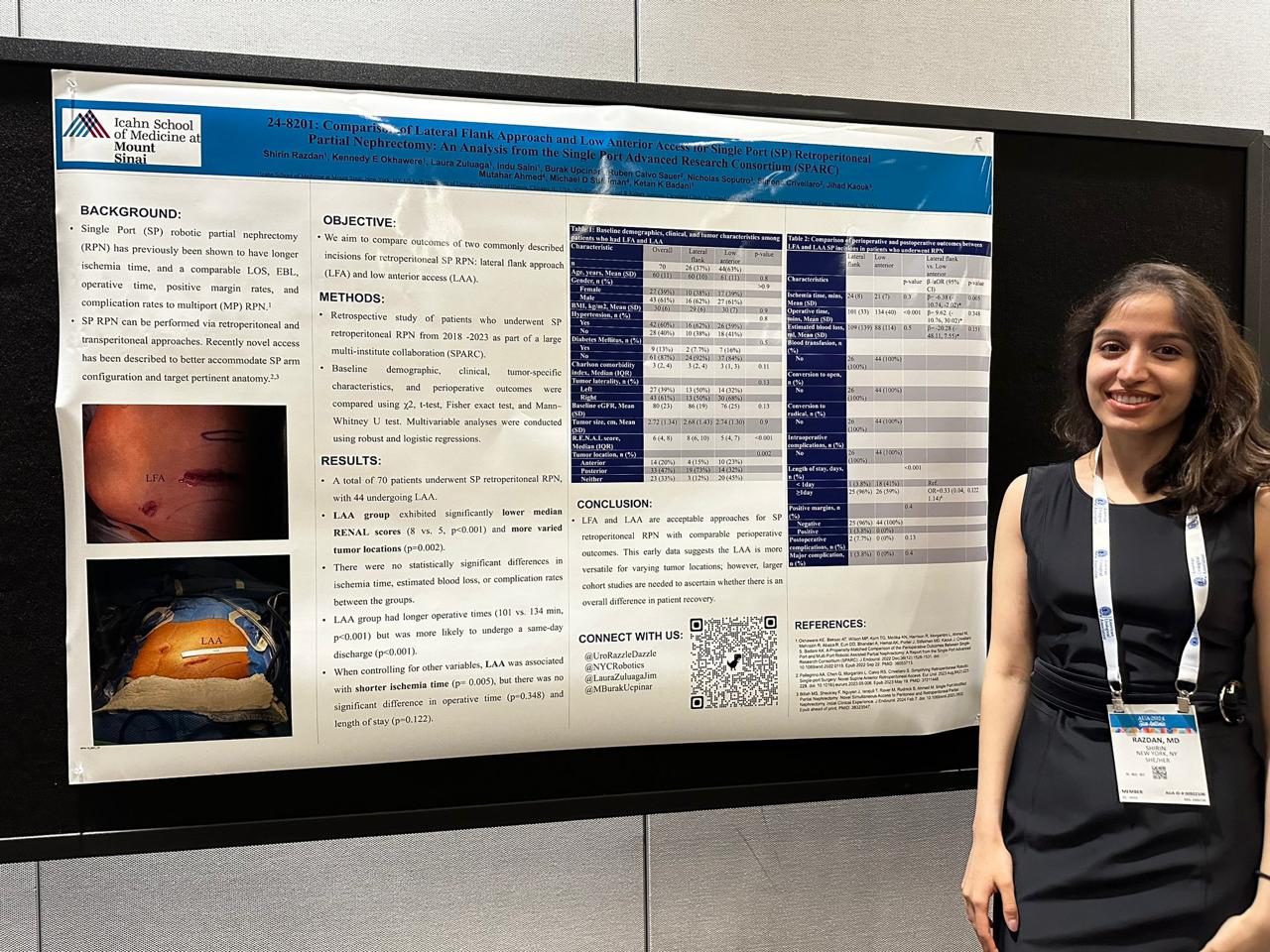
Practicing in Miami, Florida, Dr. Shirin Razdan, MD is a dual-fellowship trained, board-certified urologic oncologist specializing in advanced robotic surgery and minimally invasive urology. Having completed intensive robotic surgery and oncology fellowships at the Icahn School of Medicine at Mount Sinai in New York City, Dr. Razdan serves as Director of Robotic Surgery at the Comprehensive Urological Surgery Institute in Miami. Utilizing high-resolution cross-sectional imaging, R.E.N.A.L. nephrometry scoring, and selective pre-treatment core biopsies, Dr. Razdan guides patients through an objective comparison to determine whether surgical resection or percutaneous freezing offers the superior clinical outcome.
Understanding the Techniques: Excision vs. In Situ Thermal Destruction
The fundamental difference between these two interventions lies in whether the tumor is physically excised or destroyed in situ:
1. Robotic Partial Nephrectomy (RPN)
Robotic partial nephrectomy remains the guideline-endorsed reference standard for treating localized cT1a renal cell carcinoma:
- The Procedure: Conducted under general anesthesia via small abdominal or retroperitoneal keyhole incisions. Dr. Razdan temporarily clamps the main renal artery to establish a bloodless field (warm ischemia), sharply excises the tumor with a thin margin of healthy tissue, oversews any exposed calyces of the urinary collecting system, and reconstructs the renal defect (renorrhaphy) before restoring arterial blood flow.
- Oncologic Verification: The excised mass is extracted intact and sent to the pathologist, providing definitive confirmation of histological subtype, nuclear grade, depth of parenchymal penetration, and surgical margin status.
2. Percutaneous Renal Cryoablation
Cryoablation destroys malignant tissue inside the body using freezing temperatures:
- The Procedure: Conducted as an outpatient or 23-hour observation procedure, typically under conscious sedation or light general anesthesia. Guided by real-time cross-sectional CT or ultrasound imaging, thin cryoprobes are inserted through the skin of the flank directly into the tumor. Pressurized argon gas circulates through the probe tips, dropping temperatures below $-40^\circ\text{C}$ to form an elliptical “ice ball.”
- Biological Mechanism: The rapid freeze-thaw-freeze cycle triggers intracellular ice crystal formation, cellular membrane rupture, and microvascular thrombosis, resulting in coagulative necrosis of the lesion.
- Tissue Handling: The dead tissue is not extracted; it remains in place and gradually forms an avascular fibrotic scar that involutes over subsequent months.
Clinical Decision Factors: Efficacy, Margins, and Recovery
Comparing cryoablation and robotic partial nephrectomy involves evaluating five primary clinical domains:
[SMALL RENAL MASS DECISION MATRIX]
│
┌─────────────┴─────────────┐
▼ ▼
[ROBOTIC PARTIAL NEPHRECTOMY] [PERCUTANEOUS CRYOABLATION]
- Age < 70, surgically fit • High cardiopulmonary risk
- Tumors 2.5 to 4.0 cm • Tumors < 3.0 cm (Peripheral)
- Central or hilar location • Baseline CKD / Solitary kidney
- Definitive margin status • Avoidance of general anesthesia
- Local Oncologic Control: Robotic partial nephrectomy yields the highest primary local cure rates, with recurrence-free survival rates exceeding 97% to 98% at five years. Percutaneous cryoablation provides approximately 90% to 93% primary efficacy. Residual or recurring disease following ablation can often be successfully retreated with a secondary ablation procedure without compromising cancer-specific survival.
- Pathological Certainty: Partial nephrectomy delivers a complete histological specimen, eliminating diagnostic ambiguity. Cryoablation requires a concurrent percutaneous core needle biopsy before freezing to establish tumor type; however, biopsies can occasionally be non-diagnostic or under-grade a heterogeneous tumor.
- Anatomical Complexity: Cryoablation is ideally suited for exophytic tumors located on the posterior or lateral margins of the kidney cortex. For centrally located, endophytic, or hilar tumors adjacent to the renal pelvis, partial nephrectomy is safer; cryoablation in central regions risks thermal strictures to the ureteropelvic junction or incomplete freezing due to the “heat-sink” effect of large, warm renal blood vessels.
- Preservation of Renal Function: Both modalities preserve renal reserve significantly better than complete radical nephrectomy. Cryoablation avoids renal artery clamping entirely, making it favorable for patients with advanced baseline Chronic Kidney Disease (CKD Stage 3b/4) or a solitary functioning kidney.
Comparative Overview: Robotic Partial Nephrectomy vs. Cryoablation
| Feature | Robotic Partial Nephrectomy (RPN) | Percutaneous Cryoablation |
| Invasiveness | Minimally invasive surgery (Keyhole ports) | Percutaneous needles through skin |
| Anesthesia Type | General endotracheal anesthesia | Conscious sedation or light anesthesia |
| 5-Year Local Recurrence Rate | Lowest (~1% to 3%) | Slightly higher (~5% to 8%; retreatment feasible) |
| Histological Margin Status | Definitively verified by surgical pathology | Inferred via pre-freeze core biopsy |
| Renal Artery Clamping | Brief temporary clamping (Warm ischemia) | Zero arterial clamping (No global ischemia) |
| Optimal Tumor Anatomy | Universal: Peripheral, central, or hilar | Best for exophytic, posterior tumors <3cm |
| Bleeding / Transfusion Risk | Low-to-moderate operative risk ($1\%\text{–}3\%$) | Extremely low risk ($< 1\%$) |
| Typical Recovery Time | 1 to 2 nights in hospital; 2-week recovery | Outpatient / same-day; 2- to 3-day recovery |
Frequently Asked Questions (FAQ)
Who is the ideal candidate for cryoablation over surgery?
The ideal candidate is an older individual or a patient with significant medical comorbidities (such as severe coronary artery disease, congestive heart failure, or severe COPD) who carries an elevated risk under general anesthesia. It is also favored in patients with pre-existing renal insufficiency or genetic syndromes (such as Von Hippel-Lindau) who face recurrent small tumors throughout life.
How do doctors monitor the tumor after cryoablation if it isn’t removed?
Because the tumor remains within the kidney, patients undergo structured surveillance with contrast-enhanced cross-sectional CT or MRI at 3, 6, and 12 months, followed by annual imaging. A successfully ablated tumor loses all internal contrast enhancement (confirming lack of blood flow) and gradually contracts in size.
What are the risks of thermal injury to surrounding organs during cryoablation?
Because the colon, duodenum, and psoas muscle lie near the kidney, interventional teams utilize hydrodissection—injecting sterile dextrose or saline solution under ultrasound guidance to push adjacent intestines away from the kidney before probe activation, keeping bowel complication rates under 1%.
Conclusion
Both robotic partial nephrectomy and percutaneous cryoablation provide excellent cancer control while safeguarding long-term renal function. Robotic partial nephrectomy remains the gold standard for healthy candidates, larger tumors, and anatomically complex central lesions due to its superior primary cure rate and complete margin evaluation. Conversely, cryoablation provides a safe, minimally invasive, outpatient alternative for patients who have significant surgical risks or need to avoid general anesthesia. Consulting with a dedicated urologic oncologist ensures the treatment choice is aligned with tumor anatomy, kidney health, and personal goals.